
Mining
Your Equipment Doesn't Stop. Neither Do We.
Ventilation fans, conveyor drives, and pump stations run continuously — at remote sites with no facility Wi-Fi and minimal on-site staff. When one fails unplanned, the cost is never just the repair.
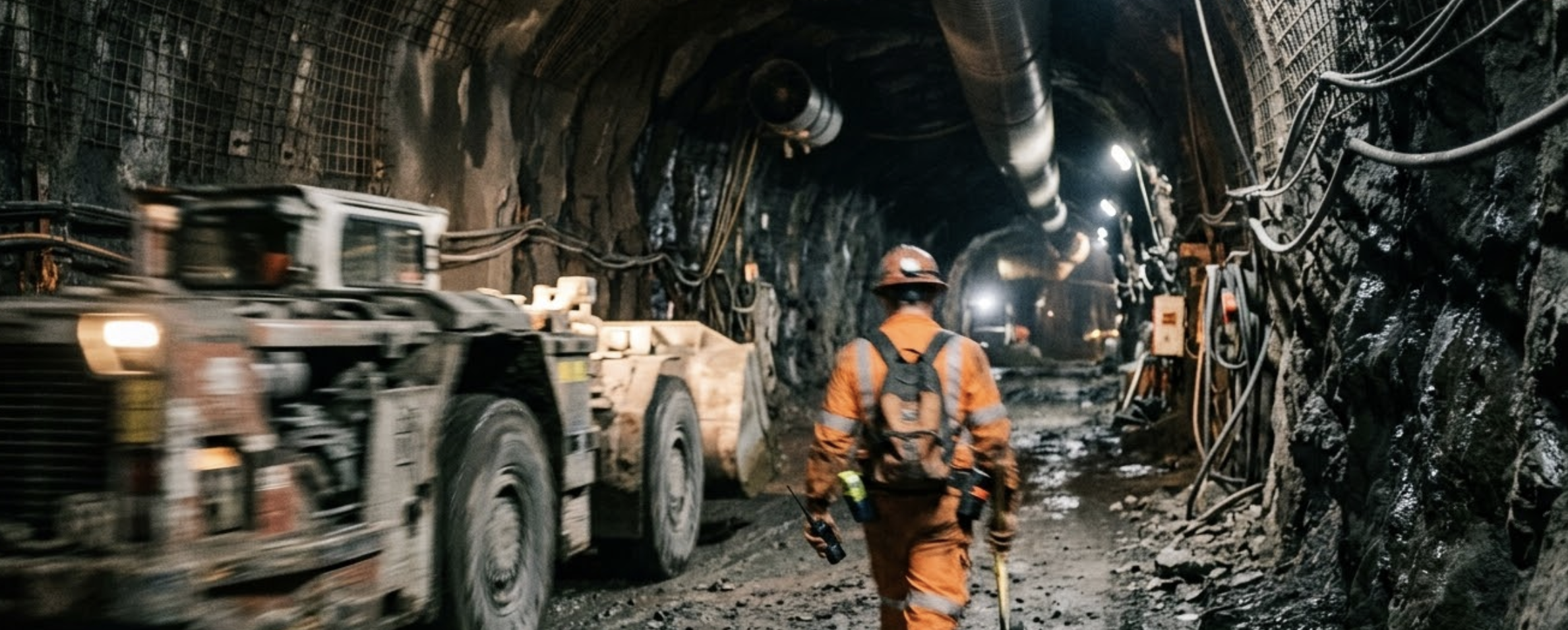
Remote sites. Minimal crew. Equipment that cannot stop.
These three conditions define the maintenance reality for most mining operations. Conventional condition monitoring was designed for facilities with IT infrastructure, dedicated reliability engineers, and short distances between the machine room and the maintenance office. Mining has none of that.
Soralink was built for environments where those assumptions fail: IP68 hardware that survives dust, water, and constant vibration; cellular connectivity that bypasses facility Wi-Fi entirely; and human-verified alerts so a two-person maintenance crew only acts on issues that are real.
Three Asset Classes. One Deployment Pattern.
Soralink specializes in fixed rotating equipment. In mining, that means three asset classes with the strongest detection record and the clearest deployment pattern.
Ventilation Systems
Primary fans, auxiliary fans, exhaust fans, underground heading fans, and their drive motors and gearboxes. Fan failure in underground operations is not a production issue — it is a safety and regulatory issue. Response time is measured in minutes, not hours.
The AI models Soralink deploys on mining ventilation fans are trained on an identical equipment class: industrial boiler fans and HVAC drive systems in food and beverage production. Same rotating geometry, same bearing configurations, same failure modes. The detection capability transfers directly to your fan room.
Conveyor Systems
Belt drive motors, take-up pulleys, gearboxes, and idler assemblies at high-criticality positions. Conveyors in surface mining operations are mission-critical — a failed drive motor on a primary haulage conveyor halts the entire extraction flow.
The same AI detection capability Soralink deploys in distribution fulfillment centers — where conveyor reliability is equally non-negotiable — applies to surface mining conveyor systems. High asset count, continuous cycles, and identical failure modes: bearing wear, misalignment, and imbalance. Deploy Sora Lite across the fleet; Sora Pro on the critical drives.
Pump Stations
Dewatering pumps, process water pumps, and pump motors. Fixed installation, predictable load profiles, high consequence of failure at remote sites. A dewatering pump that fails without warning at an underground site is not a maintenance problem — it is an operational emergency with a very short window to respond.
Pump stations have some of the most predictable vibration signatures in rotating equipment. The failure modes are well-understood, and the lead time between early detection and failure is measurable in weeks with the right monitoring in place.
Hardware Rated for the Harshest Conditions
Mining environments test every assumption conventional sensors make. Dust is constant. Water is present — from equipment cooling, drainage systems, and weather. Vibration is not incidental; it is the operating environment.
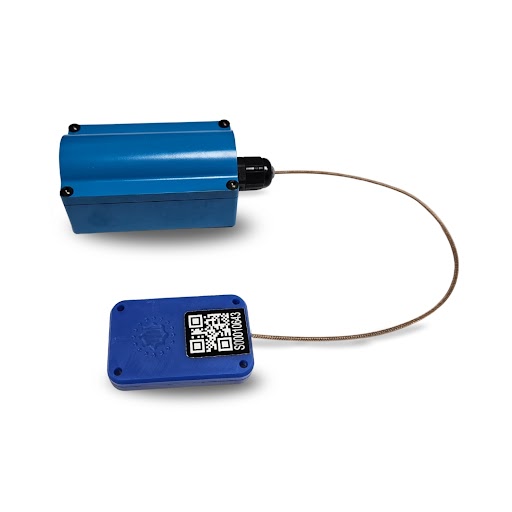
Sora Pro
High CriticalityFor variable-cycle assets and critical drives where a missed failure is not recoverable.
- IP68 rated — dust-proof, water-resistant to 1.5 m depth
- Data collected every 1 to 10 minutes (configurable)
- Exchangeable battery — zero sensor downtime
- Operating range: -30 to 60 C
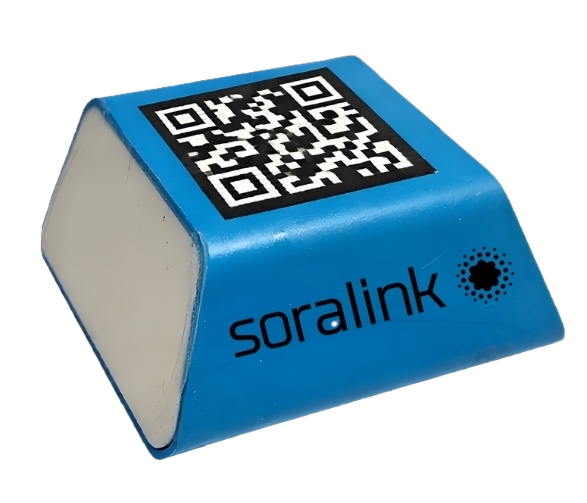
Sora Lite
Fleet ScaleFor continuous-cycle assets across a distributed fleet — conveyor drives, auxiliary fans, and pump motors.
- IP68 rated — same environmental protection, purpose-built for volume deployment
- 5-year battery life at hourly capture rate
- No power wiring or IT infrastructure required
- Operating range: -30 to 60 C
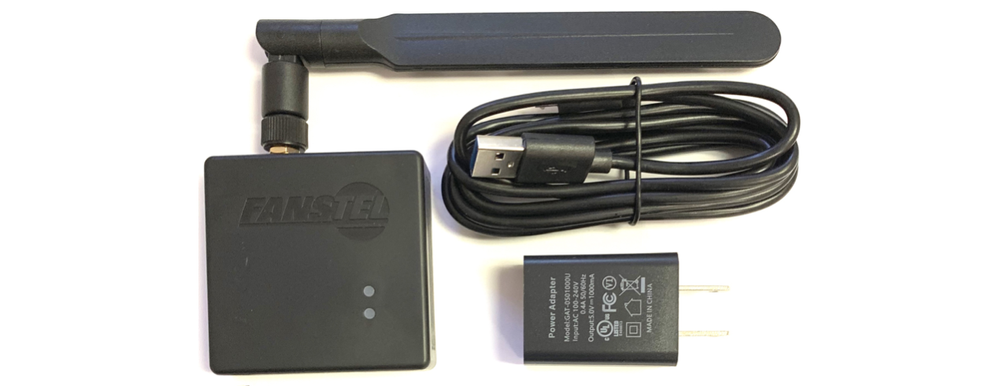
Soralink Gateway
No Wi-Fi RequiredThe dependency that defeats every other monitoring system at remote sites is network connectivity. The Soralink Gateway’s LTE model eliminates it.
- Dedicated cellular LTE — no facility Wi-Fi, no IT network required
- External antenna for maximum range in challenging RF environments
- Connects up to 50 sensors per unit
- 150 ft line-of-sight range — reliable through metal walls and enclosures
Why the AI Transfers
No mining-specific case study exists yet. We will be direct about that. What does exist is a well-established principle: the failure modes of rotating equipment do not change based on what industry surrounds the machine.
A ventilation fan in a food production facility and a ventilation fan in an underground mine are mechanically the same machine. They share the same bearing configurations, the same imbalance failure signatures, the same gearbox wear progression. The surrounding environment changes the hardware requirements — not the physics of failure.
Soralink’s AI models are built on this principle. They are trained on vibration signatures from industrial fans, conveyor drive systems, and pump stations across food and beverage production and distribution operations. Those are the same equipment classes deployed in mining. The detection capability does not require a mining-specific dataset to function — it requires the same rotating equipment, which is what you have.
The hardware is rated for what a mine actually is. The intelligence is proven on the machines you are running.
What Soralink Does Not Cover
Honest scoping is part of what makes the alerts worth trusting. Soralink is not the right tool for every asset in a mining operation.
| Asset or Scenario | Why It Is Out of Scope |
|---|---|
| Mobile equipment — haul trucks, loaders, shovels | Soralink is designed for fixed rotating assets. Mobile equipment vibration is dominated by terrain shock, not machine condition |
| Explosive atmospheres | Sora Pro and Sora Lite carry IP68 certification — not ATEX or IECEx. Deployment in methane or dust-explosive environments is not permitted |
| Crushers, ball mills, and drives below 100 RPM | Vibration amplitude at low rotational speed is insufficient for reliable accelerometer-based detection |
| Electrical failure modes | Vibration and temperature monitoring does not detect winding insulation breakdown or power quality issues |
| Reciprocating equipment — piston compressors, hydraulic cylinders | Non-rotating dynamics require specialized models not in the current Soralink offering |
Dual-Horizon Forecasting
Tactical View — 3 Weeks
Catch impending failures before they halt production
Detects sudden anomalies and deviations from each machine's individual baseline. The 3-week window gives your team enough lead time to plan an intervention without a production emergency.
Strategic View — 3 Months
Planning horizon for budget and shutdown scheduling
Tracks subtle drift from long-term machine behavior. Identifies patterns that only emerge over weeks — the kind of early signal that allows maintenance to be scheduled around planned shutdowns rather than forced by unplanned ones.
What You Get from Day One
The Same Detection Capability, Proven on Industrial Fans
No mining customers are on record yet. The testimonial below is from a dairy processing facility where Soralink detected a gearbox fault on a boiler fan — the same equipment class as a mining ventilation fan drive. The detection mechanism is identical. The hardware requirements are what change.
Share the asset types, site conditions, and connectivity constraints. We will tell you exactly what a deployment looks like — hardware, gateway placement, and what the alerts will cover.