
Case Studies
Verified Case Studies: Real Deployments, Zero Unplanned Downtime
Every number on this page comes from a live deployment — real machines, real failures caught in time, real dollars saved. No simulations, no projections.
Every vendor in this category claims 80% downtime reduction. The number is repeatable precisely because the underlying physics of predictive vs. reactive maintenance are well understood. What boards and finance committees need is not a percentage — it is a verified dollar outcome from a named facility they can check.
Customer names are withheld at their request. References are available during evaluation.
The two primary cases below are drawn from live deployments, not trials. One dairy facility avoided $250,000 in downtime costs from a single bearing failure caught with a 3-week planning window. One meat processing plant avoided $65,000 in repair and spoilage costs from a check valve failure caught in real time. Both outcomes are supported by customer statements. The payback period in each case was under 3 months.
The other cases on this page address safety-critical and agricultural deployments where the financial framing is secondary to operational continuity — but the verification standard is the same.
Case Study #01: Bearing Failure — Top-10 Dairy Manufacturer
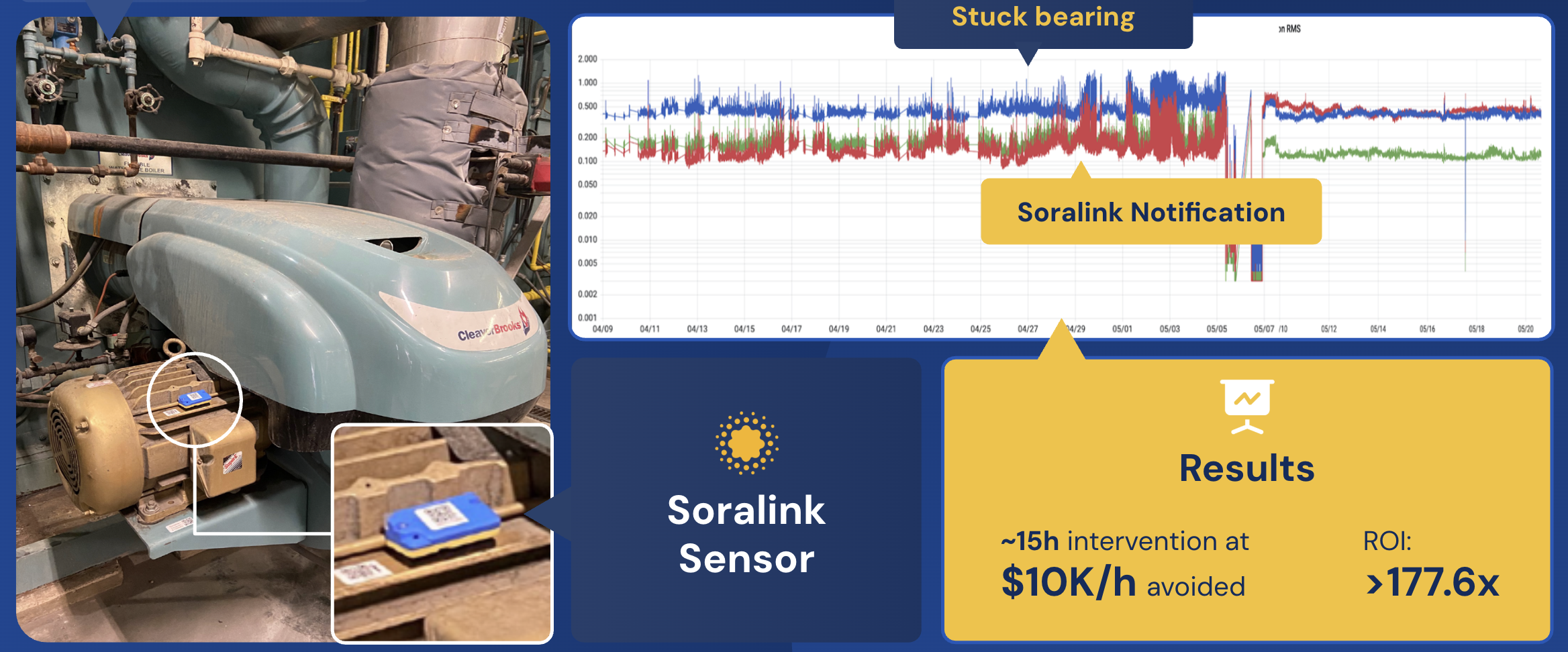
A large-scale dairy facility ran time-based maintenance intervals on its main boiler fan motor. Emergency intervention on this asset runs at $10,000 per hour.
Within 2 weeks of sensor deployment, Sora Insight detected an early-stage bearing deviation — a signal too subtle to trigger any existing threshold alarm. The Sora Care team validated it as a confirmed, progressing anomaly and notified the maintenance team with a 3-week planning window to act.
| Metric | Result |
|---|---|
| Early warning lead time | 3 weeks |
| Emergency hours avoided | ~25 hours |
| Emergency cost rate | $10,000 / hour |
| Total downtime cost prevented | $250,000 ¹ |
“In less than a month of use, Soralink helped us save thousands of dollars from unplanned downtime. A gearbox had to be replaced on the fan of our main boiler. We detected it thanks to Soralink, and were able to plan the production downtime to carry out the intervention.”
— J. Brochu, Dairy Processing Plant
¹ Calculated from the facility’s stated emergency intervention rate of $10,000/hour × ~25 hours of avoided emergency work.
Case Study #02: Check Valve Failure — Meat Processing Plant
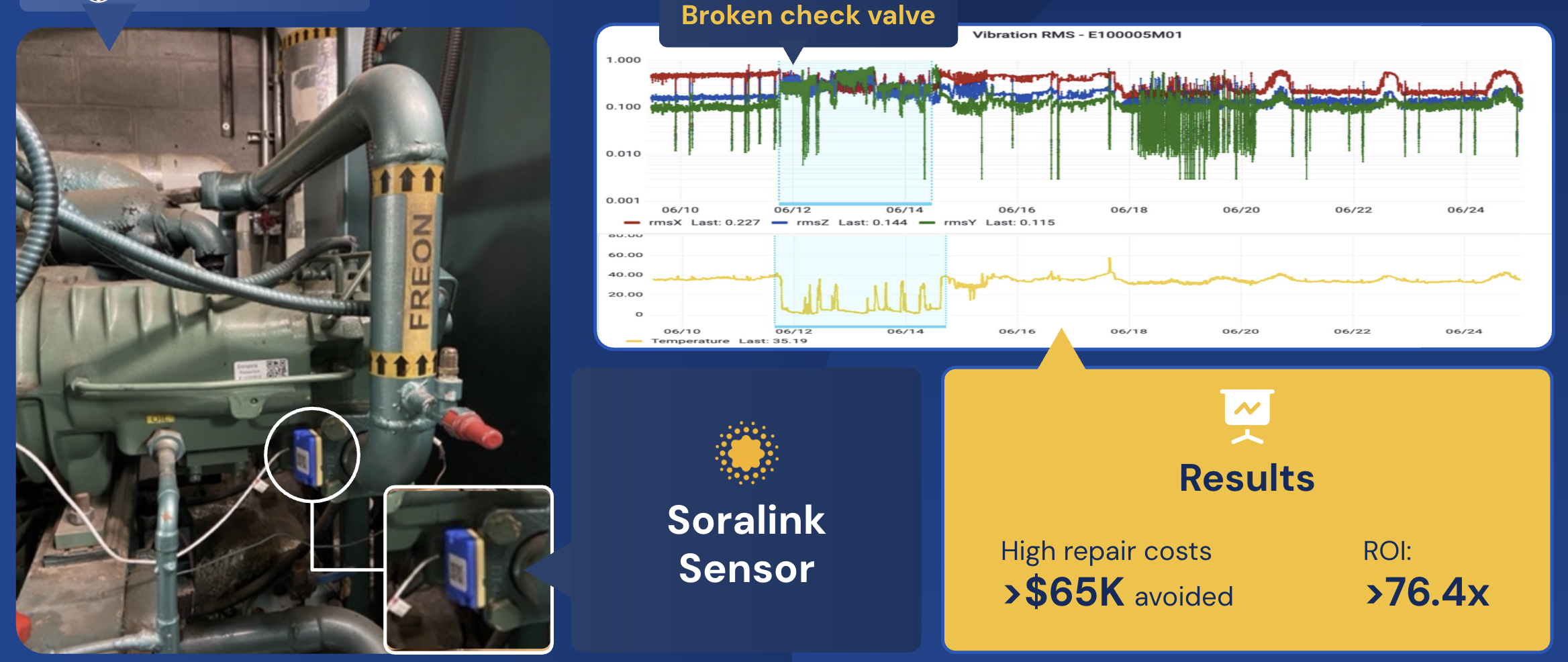
A meat processing facility depended on industrial compressors running continuously for cold chain compliance. When a check valve broke, Soralink detected the event through two simultaneous signals: a sharp shift in the compressor’s vibration pattern and a sudden temperature drop from over 20°C down to 4°C.
The Sora Care team validated the anomaly as a confirmed mechanical failure. Maintenance was dispatched and confirmed the cracked check valve. The repair was completed before significant refrigerant had escaped.
| Metric | Result |
|---|---|
| Detection signal | Vibration shift + temperature drop |
| Alert quality | Human-verified — zero false positives |
| Product spoilage prevented | Full cold storage inventory |
| Total repair costs avoided | $65,000+ |
“Soralink’s system allowed us to react on time when a check valve broke in our compressors and more than half of the refrigerant was lost. We saved repair costs that could have been very high.”
— F. Moreau, Meat Processing Plant
Case Study #03: Pump Cavitation — Crop Irrigation System
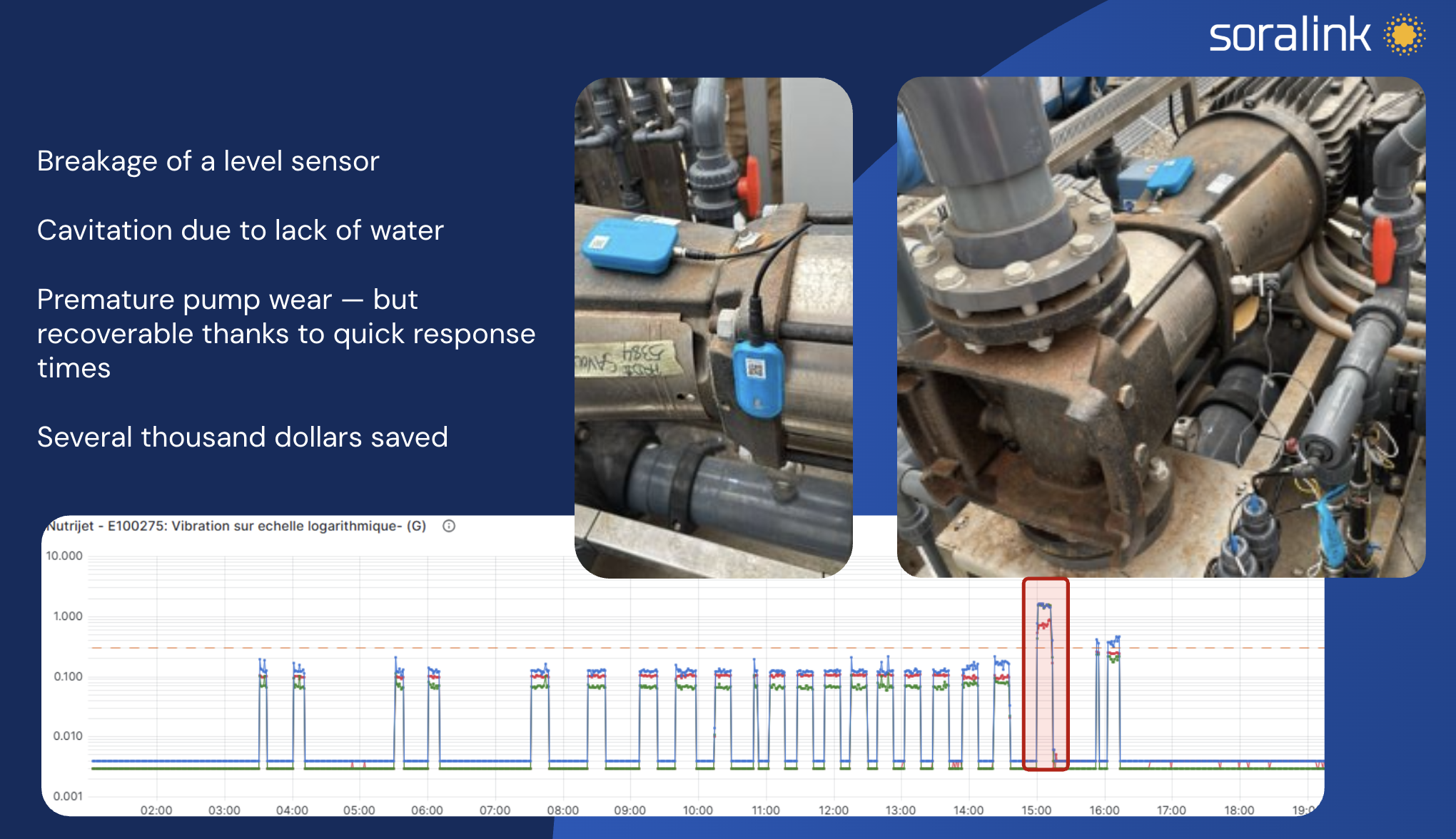
Large-scale agricultural irrigation systems represent Criticality Level 1 assets due to a complete lack of redundancy. A failed level sensor can cause a pump to run dry, leading to catastrophic cavitation that destroys the equipment and halts the essential flow of water.
Soralink’s real-time alerts identified the vibration spikes associated with cavitation even as the system was in its early stages of failure. This allowed for an immediate response, resulting in only minor “recovered” pump wear instead of a full replacement.
| Metric | Result |
|---|---|
| Detection signal | Vibration signature of early-stage cavitation |
| Response time | Same-day intervention |
| Operational impact | Zero water distribution interruption |
| Pump replacement cost avoided | $8,000–$10,000 |
“Saved several thousand dollars by catching early-stage cavitation in a critical pump. Recovered premature pump wear through rapid response times enabled by the dashboard.”
— Maintenance Team, Agriculture Deployment
Case Study #04: Multi-Machine Failure — Kettle Drive Synchronization
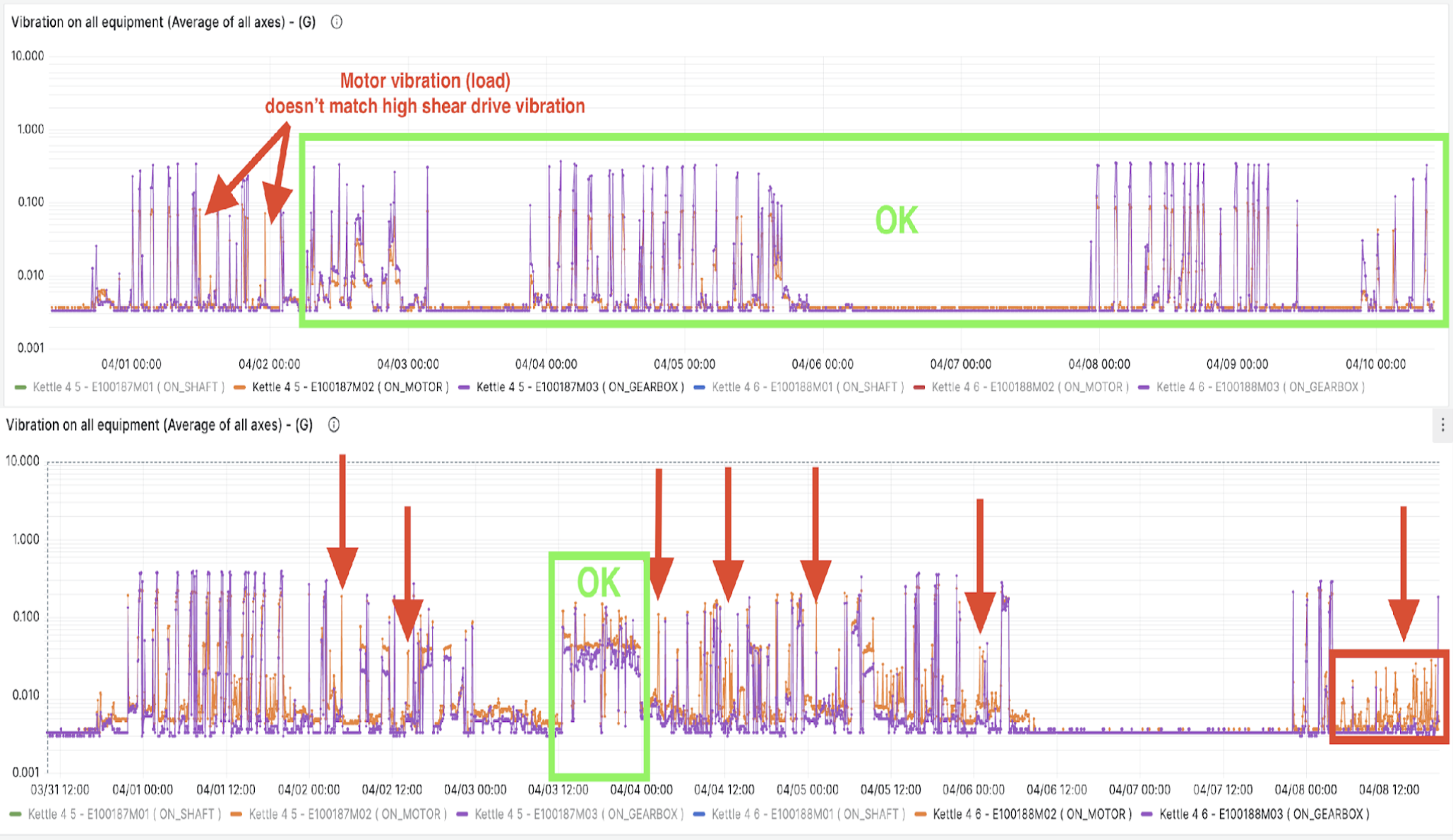
A food and beverage manufacturer running high shear drives and kettle motors was experiencing recurring equipment failures that standard isolated sensors consistently failed to predict. Each machine appeared healthy on its own — no individual vibration spike, no standalone threshold breach.
Soralink’s cross-machine telemetry analysis identified the root cause: the motor’s vibration load signature was not tracking the high shear drive’s vibration pattern the way a healthy coupled system should. The mismatch only became visible when both asset traces were overlaid in real time — the motor was carrying a load profile inconsistent with what the high shear drive was producing. A threshold-based system monitoring either machine in isolation would have missed it entirely.
| Metric | Result |
|---|---|
| Detection method | Cross-machine vibration trace correlation |
| Root cause | Motor load vibration not matching high shear drive vibration |
| Detectable by isolated sensors | No |
| Production line halt | Prevented |
Join the industrial operators who made the switch to AI-driven maintenance.