
According to a 2024 Siemens report, the world’s 500 biggest companies lose almost $1.4 trillion annually through unplanned downtime, equivalent to 11% of their revenues. This significant financial loss is primarily due to a lack of structured maintenance schedules, resulting in sudden equipment failures that are addressed only after production has stopped. However, by transitioning to a data-driven predictive maintenance strategy, companies can recoup these lost revenues and optimize their operational efficiency. The five most critical questions to help optimize your maintenance work are outlined below.
#1 Is My Business Too Small to Implement a Predictive Maintenance Program?
There is no size threshold for predictive maintenance; any facility with critical assets, such as pumps, refrigeration systems, or fans, can benefit from predictive analytics. Data from our recent implementations shows that for smaller facilities, the cost of a single unplanned breakdown often exceeds the annual subscription cost of a full predictive sensor suite. Even monitoring a single high-value asset using predictive maintenance techniques, businesses consistently shift from reactive “emergency” budgets to predictable, optimized maintenance spend, proving that the solution is mathematically profitable regardless of total size.
#2 How Many Sensors Are Needed to Reduce Unplanned Downtime Effectively?
You do not need to instrument every machine at once; we recommend a scalable strategy using an MVP (Minimum Viable Product) approach focused on the critical 20% of assets that typically drive 80% of your unplanned breakdowns. A targeted deployment of 3–5 sensors provides sufficient baseline data to validate machine learning insights. This allows you to scale your monitoring coverage based on proven performance results.
#3 What Data Types Should a Modern Maintenance Work Plan Analyze?
In order to capture over 90% of mechanical failure modes, a robust maintenance system must integrate high-fidelity data streams — specifically 3-axis vibration, temperature, and acoustics. Soralink’s solution leverages AI and machine learning to analyze this maintenance data, identifying subtle deviations that remain invisible to standard isolated sensors.
Predictive Maintenance Use Cases: The Power of Multi-Dimensional Diagnostics
Take the case of a food and beverage manufacturer experiencing recurring equipment failures that standard, isolated sensors consistently failed to predict. While individual machines appeared healthy, Soralink’s cross-machine telemetry revealed a load mismatch between the motor and the high-shear drive that was only visible when vibration traces were overlaid.
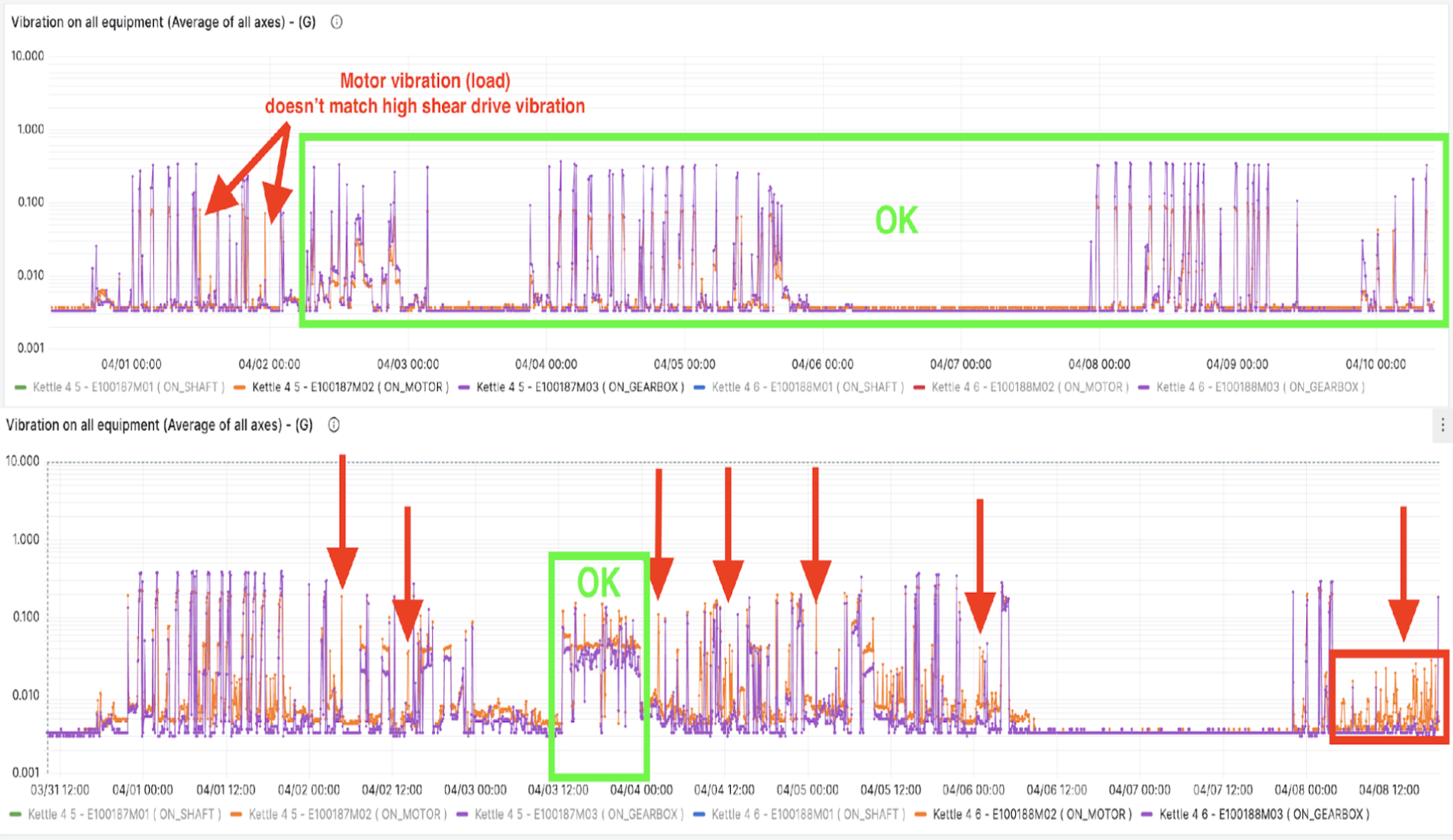
This predictive maintenance approach enables teams to schedule maintenance during planned production gaps, replacing reactive maintenance with data-driven reliability and eliminating the risk of unplanned breakdowns.
#4 How Much Does a Predictive Maintenance System Cost?
Some service providers require you to purchase the entire solution upfront, while Soralink’s monthly subscription model provides full access to our Industrial Predictive Maintenance Platform without the need for large capital outlays. This enables you to implement a predictive maintenance plan immediately, converting reactive maintenance costs — such as production delays, overtime following a breakdown, and fees for urgent delivery of repair parts — into predictable operating expenses.
Soralink’s customers report saving an average of 30% on their annual maintenance costs by switching to predictive maintenance. How much would that 30% savings amount to for your business?
Curious about the ROI of your specific equipment? Request a Demo.
#5 How Does Soralink Predict Breakdowns and Malfunctions?
Predictive maintenance uses data to determine when a machine will require maintenance, before a breakdown occurs. Here’s how Soralink’s predictive maintenance process works:
Data Collection
Sensors continuously collect real-time data on the performance and operating conditions of your equipment.
Data Analysis
The collected data is analyzed using advanced algorithms, AI, and machine learning. This identifies trends or anomalies that may indicate potential future issues.
Alerts and Notifications
When predictive models detect an imminent risk, our expert validates the anomaly to ensure zero false positives before generating alerts. This enables the maintenance team to plan and perform any necessary maintenance before a failure occurs, thereby reducing unplanned downtime and associated costs.
Continuous Optimization
Predictive maintenance models are continuously refined as new data is collected. This allows maintenance strategies to be optimized over time, maximizing equipment availability while minimizing costs.
Other Questions About Predictive Maintenance
Q: What is the main difference between preventive and predictive maintenance? A: Preventive maintenance relies on scheduled intervals to reduce the likelihood of failure. Predictive maintenance uses real-time sensors, such as the Sora Pro or Sora Lite, to detect signs of deterioration before failure occurs. More details.
Q: Can I integrate my existing sensors into Soralink’s Platform? A: Yes. Integrate any sensor (Amazon Monitron, IO-Link, AWS IoT Core, etc.) with Sora Bridge. Take advantage of centralized alerts and expert validation without replacing your existing hardware.
If you’d like assistance with implementing predictive maintenance in your company or simply want to discuss your challenges, you can contact us, follow us on LinkedIn, or subscribe to our newsletter to stay up to date on the latest news in this field.