

Unplanned downtime is one of the costliest challenges in manufacturing. According to Forbes, industrial sectors lose up to $50 billion annually due to such disruptions. With a variety of maintenance strategies available, ranging from reactive and preventive to predictive, choosing the right approach for your assets is crucial in order to mitigate these losses. However, there is no one-size-fits-all maintenance plan; the decision depends on your current maintenance costs, operational reality, budget, and asset criticality. This guide clarifies the differences between various maintenance strategies, provides a decision-making framework to evaluate your maintenance costs, and helps your maintenance team build an effective maintenance program tailored to your specific operational reality.
What Are the Core Differences Between Reactive, Preventive, and Predictive Maintenance Strategies?
Maintenance strategies are categorized by their timing and intervention triggers. Preventive maintenance relies on scheduled intervals to reduce the likelihood of failure. Predictive maintenance uses real-time sensors, such as the Sora Pro or Sora Lite, to identify signs of deterioration before failure occurs, whereas reactive maintenance only acts after a breakdown has occurred. Let’s take a deeper look at these different types of maintenance.
Preventive Maintenance
Preventive maintenance is certainly the most traditional method among those presented in this article. According to AFNOR, preventive maintenance is based on “maintenance performed at predetermined intervals or according to prescribed criteria, intended to reduce the likelihood of failure or deterioration in the performance of an asset.”
Think of it as a series of periodic inspections, much like having your car serviced every 5,000 to 8,000 km, to proactively reduce the chances of equipment failure by carrying out routine maintenance tasks at regular intervals. This approach generally divides into two types:
- Time-based maintenance or usage-based maintenance: Scheduled based on time or the number of units produced (e.g., Part A is replaced every 4 months or after 10,000 units have been produced).
- Condition-based maintenance: Monitoring signs of wear or fatigue (e.g., tires are replaced when wear reduces tread depth to X mm).
Predictive Maintenance
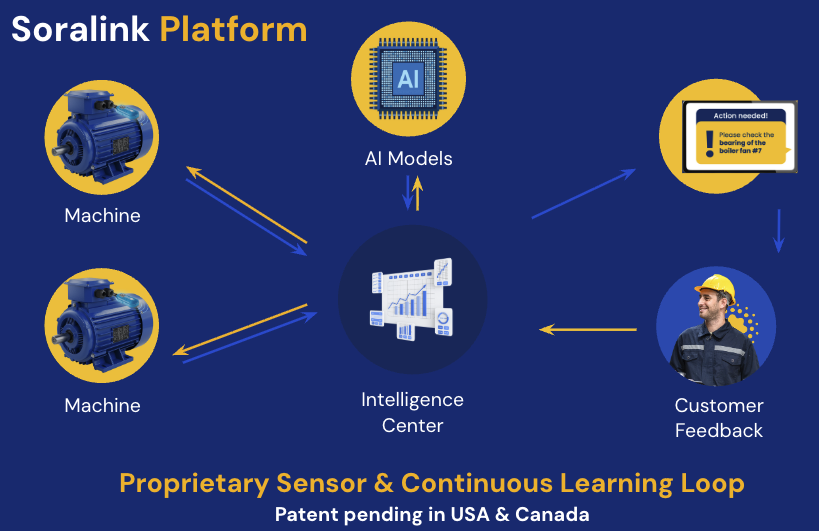
Predictive maintenance (also known as anticipatory or proactive maintenance) aims to identify signs of deterioration before a component fails completely. The principle is that every part, system or component exhibits signs, whether visible or not, that indicate an impending failure, breakage or malfunction. We can identify and predict problems before they occur by leveraging advanced predictive technology, such as smart sensors like Sora Pro or Sora Lite, to monitor at-risk components through real-time measurements of temperature, vibration, pressure and decibels.
Rather than reacting to unplanned maintenance issues or relying solely on fixed maintenance schedules, predictive maintenance seeks to avoid production downtime by accumulating data to plan maintenance work when it is needed.
Reactive Maintenance
Reactive maintenance refers to all tasks performed to correct or repair malfunctioning equipment. The goal is simple: to restore broken or obsolete systems to working order. This approach — often described as corrective maintenance — should be managed carefully within your broader maintenance operations.
Indeed, reactive maintenance work can be planned (when an inspection determines that a part is too worn) or unplanned. The latter, often categorized as emergency maintenance, occurs due to unexpected breakdowns and poses the greatest risk to production.
This type of maintenance is, in most cases, unavoidable, as it is the logical next step following preventive and predictive maintenance. However, it becomes problematic when it dominates your equipment maintenance efforts. Heavy reliance on unplanned reactive maintenance can result in costly downtime, losses, and delays. Therefore, experts often refer to the “80-20” rule for balanced maintenance activities: 80% preventive/predictive and 20% reactive.
To help you quickly grasp the key distinctions, here is a breakdown of how reactive, preventive, and predictive maintenance compare across core operational metrics:
| Reactive | Preventive | Predictive | |
|---|---|---|---|
| Trigger | Acts only after an equipment failure occurs. | Performed at predetermined maintenance schedules. | Triggered by real-time status/data alerts. |
| Downtime Risk | High; leads to unplanned downtime and emergency maintenance. | Low to Moderate; downtime is planned but might be unnecessary. | Minimal; maintenance interventions are precisely planned before a breakdown. |
| Cost Implications | High | Moderate | Lowest long-term cost; no upfront CapEx with Soralink’s subscription. |
| Main Advantage | No upfront planning required. | Easy to implement and schedule. | Maximizes asset lifespan and eliminates downtime. |
| Main Disadvantage | Highly disruptive and expensive. | Risks replacing parts that are still functional. | Requires advanced predictive technology (fully managed by Soralink). |
How to Choose the Right Maintenance Strategy?
Although every company is unique, the questions and considerations regarding maintenance decisions are very similar. Choosing the right strategy is not about picking one method exclusively; it is about finding the optimal balance of maintenance interventions to maximize asset reliability while minimizing costs. To determine the best path for your facility, we recommend a four-step framework that aligns your technical requirements with your business objectives:
1 — Evaluate the “Hidden” Costs of Your Current Approach
The first step is to take an honest and realistic look at the overall maintenance costs of your current situation. Of course, you need to factor in the cost of replacement parts and the maintenance team’s labor costs, but it’s essential to highlight how much breakdowns and unplanned downtime are costing you:
- Employees are being paid even though the production line is down
- Loss of raw materials
- Delivery delays
- Loss of contracts
2 — Assess Your Operational Reality
Before committing to a specific maintenance strategy, evaluate your operational reality by considering these critical factors:
- Does your manufacturing business operate outside of the maintenance team’s working hours?
- Are critical replacement parts readily available?
- Do you have the personnel to carry out constant manual and visual inspections of all your equipment at any time?
- What recurring issues are you looking to resolve?
3 — Align Your Maintenance Budget with Your Strategic Needs
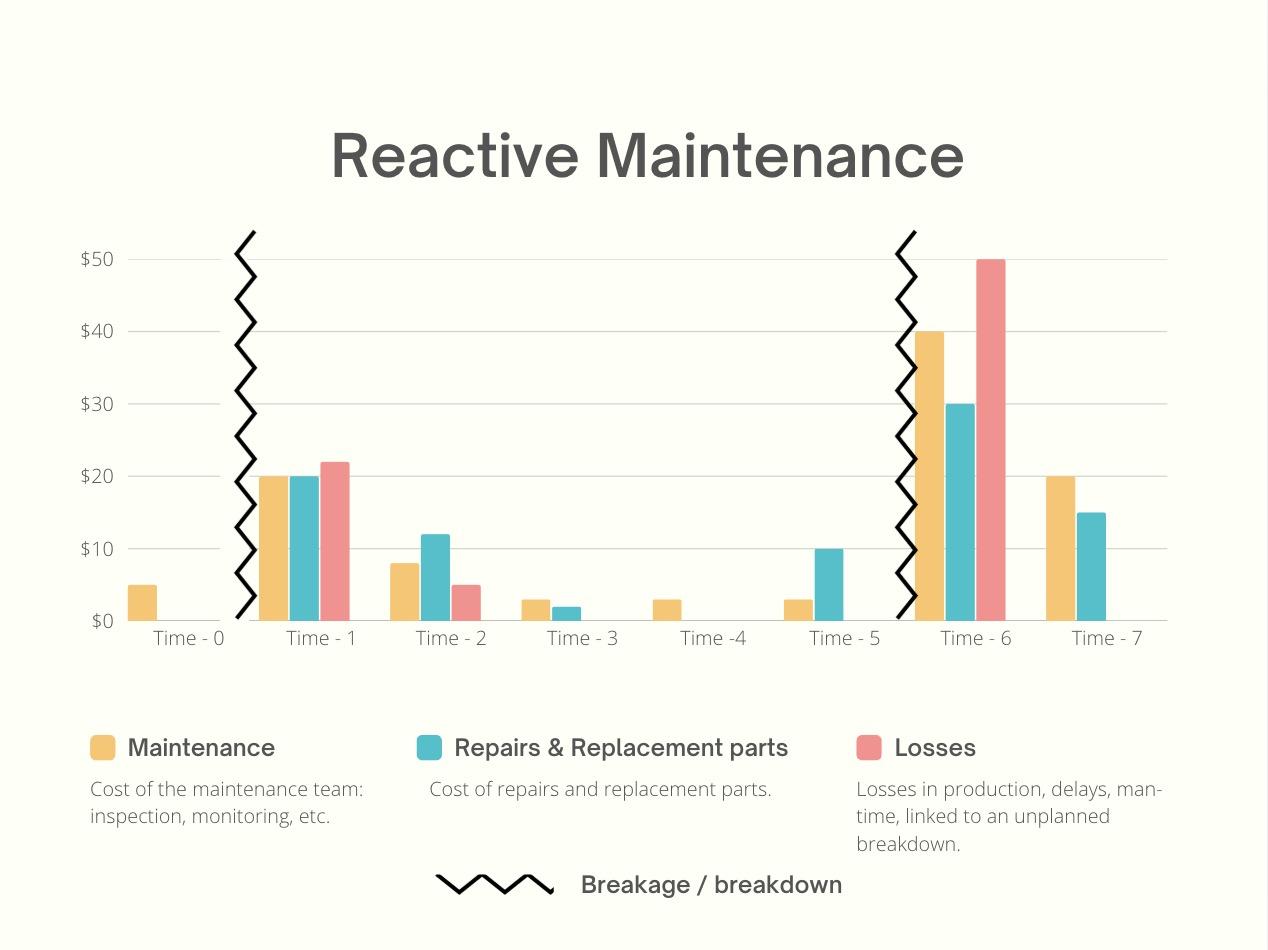
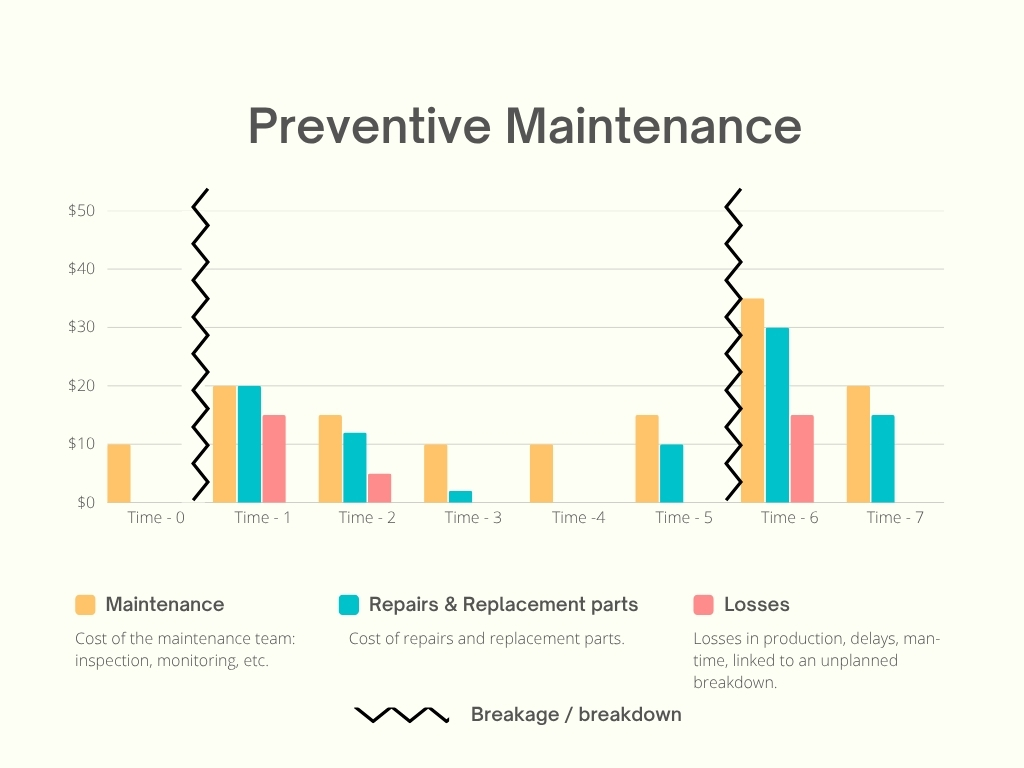
The total cost of your maintenance operations depends on the strategy you adopt. The industry consensus is that companies consistently fall into one of three patterns.
Reactive maintenance only — highest total cost due to unplanned downtime and emergency labor:
Preventive maintenance — moderate cost, but carries the risk of replacing parts that are still functional:
Predictive maintenance — highest upfront visibility, lowest long-term cost. At Soralink, no upfront capital investment required (monthly subscription model):
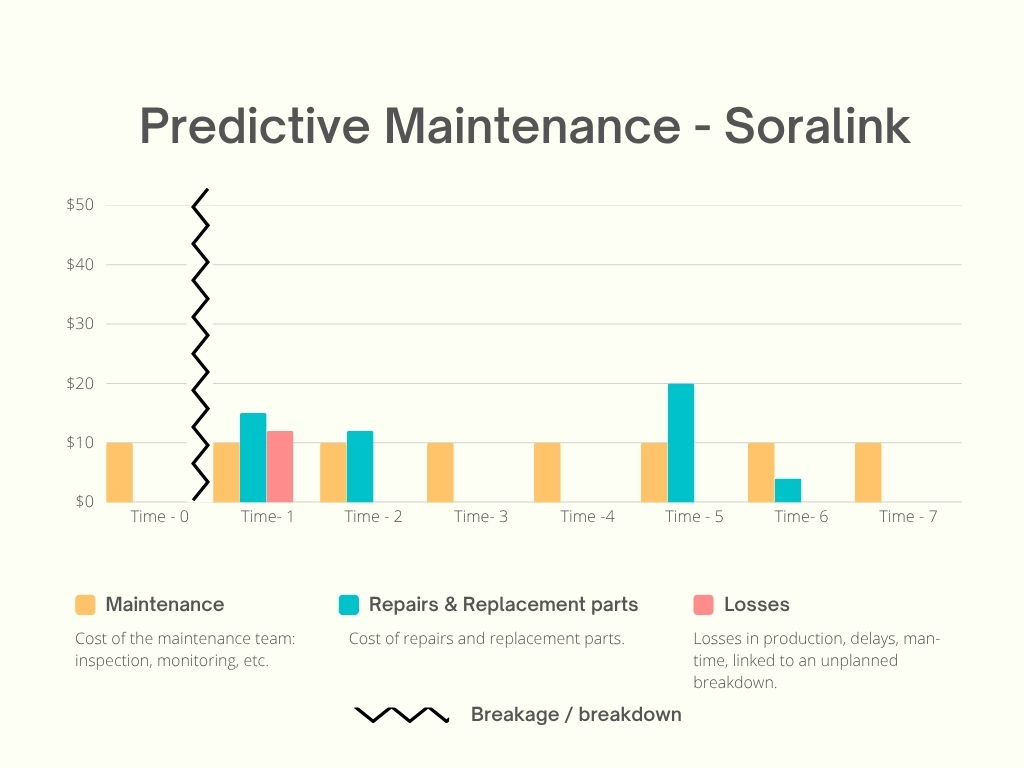
Traditional predictive models often require substantial upfront capital investment to purchase hardware and infrastructure, creating high entry barriers and complex financial forecasting:
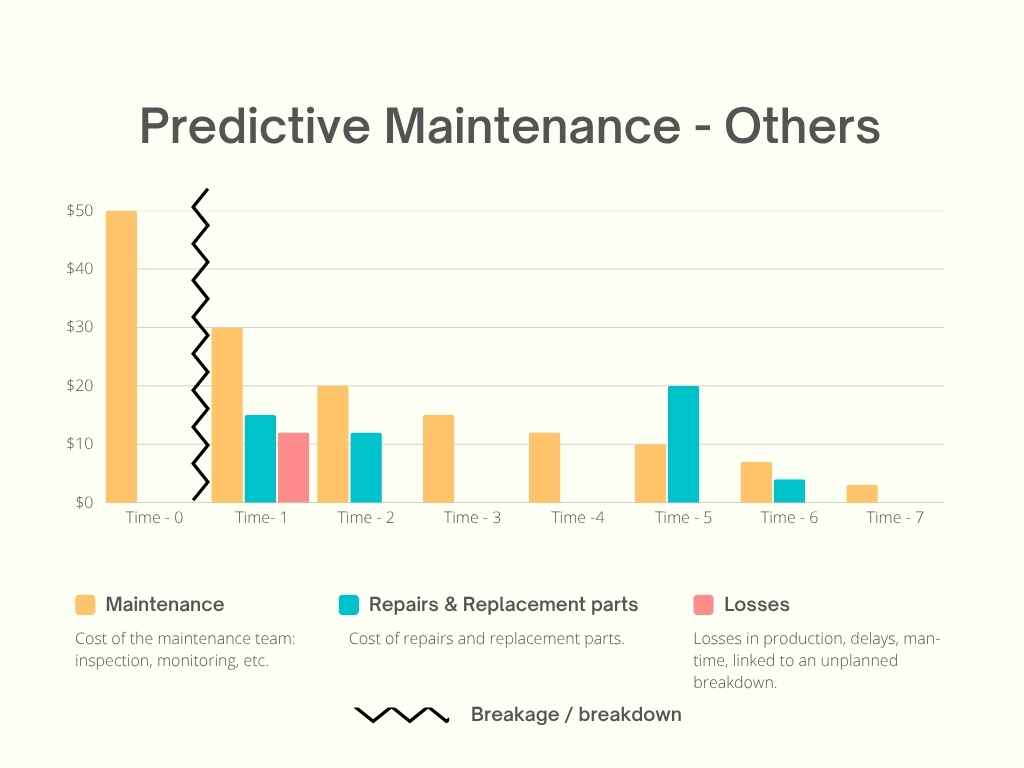
4 — Define Your Ideal Maintenance Plan
By combining the information from steps 1, 2, and 3, you can now choose between reactive, preventive, and predictive maintenance with confidence. The ultimate goal is to choose a method that fits your circumstances, your budget, and, above all, offers improvements over your current situation.
Consider this framework to identify the right maintenance type for your specific assets:
- Critical machines: Predictive is essential to guarantee operational continuity and cut down on costly downtime.
- Semi-critical machines: Preventive is often a good compromise.
- Non-critical machines: Reactive may be acceptable if they do not impact safety or overall throughput, preventing unnecessary maintenance spend on low-value assets.
As Forbes highlights, “Having a well-run, efficient maintenance program that can identify and rectify equipment problems before failure rather than after is key to reducing downtime and its costs.” By leveraging predictive analytics to tailor your efforts, you transition from fire-fighting to a modern maintenance framework that aligns perfectly with your business goals.
Transform Your Maintenance Management with Soralink
The good news is Soralink can help. We provide an AI-powered PdM platform with expert validation that integrates temperature, sound, and vibration data — alongside IoT, AI, and analytics — into an integrated solution. From sensors to AI insights to prescriptive actions, we empower your team to transition from run-to-failure maintenance to a more proactive maintenance approach that protects assets, reduces operational downtime, and lowers maintenance costs.
Contact us now to request a personalized assessment of your facility’s needs. If you’d like assistance implementing predictive maintenance in your company or simply want to discuss your challenges, you can contact us, follow us on LinkedIn, or subscribe to our newsletter to stay up to date on the latest news in this field.